Filipinos working, studying, or doing business overseas often need to prove that their Philippine-issued documents are legitimate. Whether you’re an OFW processing an employment contract, a student applying to a foreign university, or a business owner expanding abroad, proper document authentication is essential.
This guide explains the differences between the Red Ribbon, Apostille, and other authentication methods. You’ll learn when each one is required, how to process them, and what documents you need to prepare.
Understanding document authentication
What it means
Document authentication is the process of verifying that a Philippine-issued document is genuine. It ensures that foreign governments, employers, schools, and institutions can trust the validity of your papers.
Why it matters
Many countries require authenticated documents before they accept visa applications, employment contracts, academic credentials, or legal papers. Without proper authentication, your application may be delayed or rejected.
The Red Ribbon system
What is the DFA Red Ribbon?
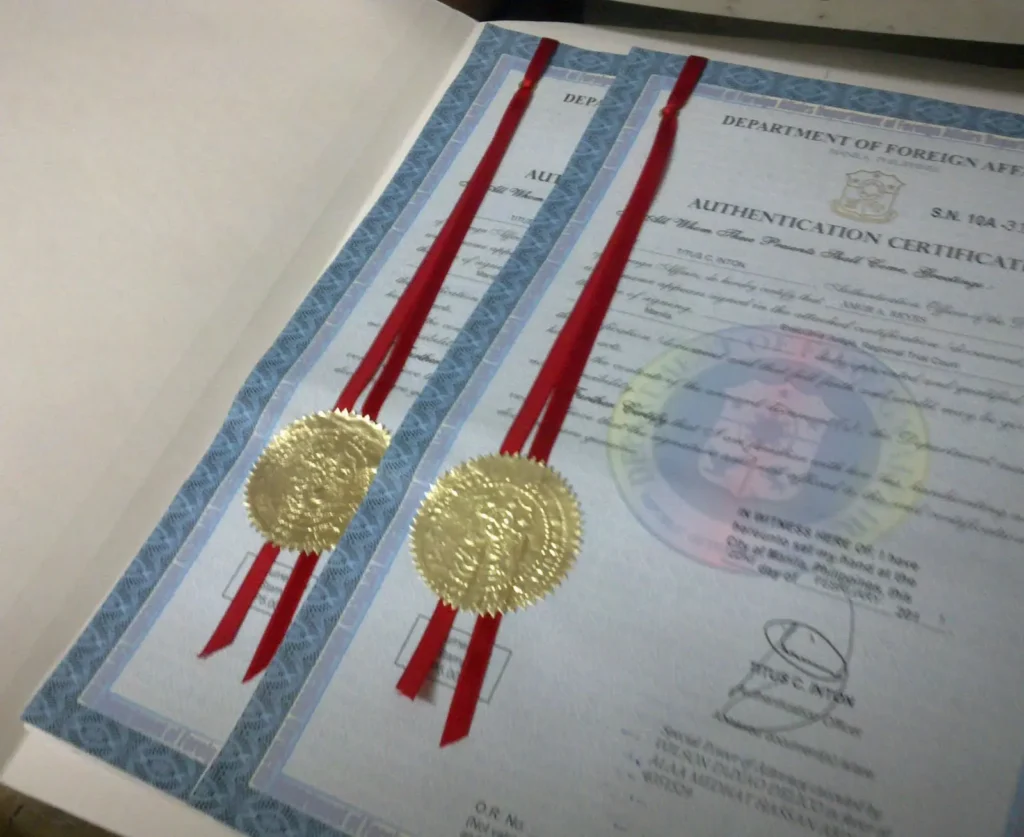
Before the Apostille system was introduced in 2019, the Department of Foreign Affairs (DFA) used the “Red Ribbon” to authenticate documents. This was a physical red ribbon attached to the document to certify its authenticity.
 When the Red Ribbon is still needed
Although the Apostille has replaced the Red Ribbon for most countries, some nations that are not part of the Hague Apostille Convention still require the traditional Red Ribbon. These include:
- United Arab Emirates
- Qatar
- Kuwait
- Saudi Arabia
- Other non-Hague Convention countries
Step-by-step process for Red Ribbon
- Notarize the document (if applicable).
- Secure certification from the issuing agency (e.g., DepEd, CHED, PRC, PSA).
- Submit to DFA for authentication at a consular office.
- Pay the authentication fee and wait for the release of the Red Ribbon.
Tips for Red Ribbon processing
- Ensure your document is original, clean, and readable.
- Check the receiving country’s requirements before processing.
- Bring photocopies to avoid delays.
Apostille: the modern standard
What is an Apostille?
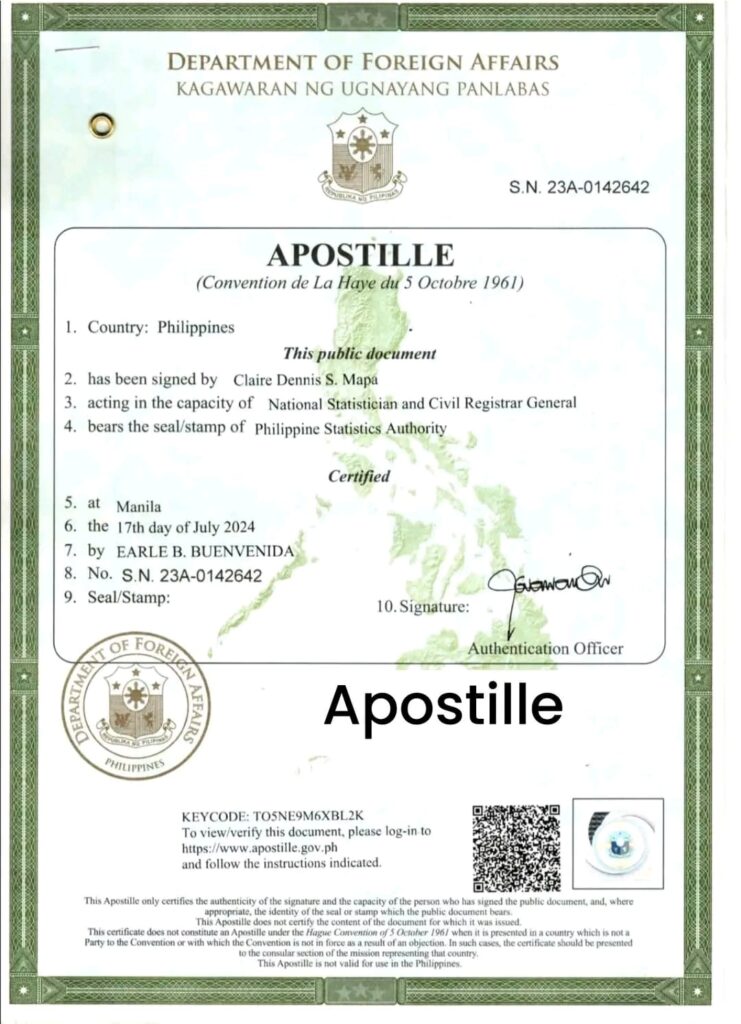
An Apostille is an internationally recognized certificate issued under the Hague Apostille Convention of 1961. It simplifies the authentication process for documents used in countries that are signatories to the convention.
 Countries that accept Apostille
More than 100 countries accept Apostille, including:
- United States
- Canada
- Australia
- United Kingdom
- Japan
- South Korea
- Most European Union member states
Note that even though they are Hague members, Germany, Austria, Finland, and Greece currently maintain specific objections to the Philippine accession. Philippine documents for these countries still generally require additional “legalization” by their respective embassies in Manila.
Step-by-step process for Apostille
- Secure the original or certified true copy of your document.
- Have it notarized if required.
- Submit the document to the DFA Apostille service.
- Pay the Apostille fee.
- Claim the document with the Apostille attached or stamped.
Benefits over Red Ribbon
| Red Ribbon | Apostille |
|---|---|
| Requires additional embassy authentication | No embassy authentication needed for Apostille countries |
| Longer processing time | Faster and simpler |
| Used only for non-Hague countries | Accepted by 100+ countries |
Other types of document authentication
Embassy or consular authentication
For countries that are not part of the Apostille Convention, documents may require:
- DFA Red Ribbon
- Embassy or consulate authentication
This is common for Middle Eastern countries, where embassy stamping is still mandatory.
Local government authentication
Some documents require additional verification before DFA processing, such as:
- Notarization by a local notary public
- Certification from DepEd, CHED, PRC, or other agencies
- Local civil registrar certification for PSA documents
Required documents
Common documents submitted for authentication include:
- PSA-issued certificates (birth, marriage, death)
- Diplomas and Transcript of Records (TOR)
- Notarized affidavits, contracts, or certifications
- Professional licenses (PRC)
- Valid government-issued ID
Processing steps and fees
Red Ribbon
- Payment methods: DFA payment kiosks or online channels
- Processing time: 3–7 working days
Apostille
- Appointment: DFA online appointment system is recommended
- Processing time: 1–3 working days depending on location
Embassy authentication
Fees and schedules vary by embassy. Always check the official website of the receiving country’s embassy or consulate.
Tips for a smooth authentication process
- Check the receiving country’s requirements before starting.
- Use original or certified true copies only.
- Keep digital copies for backup.
- Book DFA appointments early.
- Avoid last-minute processing before deadlines.
Common mistakes to avoid
- Submitting damaged or unreadable documents.
- Skipping notarization or agency certification.
- Confusing Red Ribbon with Apostille.
- Not checking country-specific rules.
Conclusion
The Red Ribbon, Apostille, and embassy authentication each serve different purposes. The Red Ribbon is the traditional method still required by non-Hague countries. The Apostille is the modern, internationally recognized standard for most destinations. Embassy authentication is needed only for specific countries that require additional verification.
Preparing your documents early and following the correct steps ensures your papers will be accepted abroad without delays. Whether you’re an OFW, student, or entrepreneur, proper authentication is a crucial part of your international journey.
References
[1] Department of Foreign Affairs – Apostille Information: https://dfa.gov.ph/dfa-apostille
[2] Hague Conference on Private International Law – Apostille Convention: https://www.hcch.net/en/instruments/conventions/specialised-sections/apostille
[3] PSA – Civil Registry Documents: https://psa.gov.ph