Ottawa is a city that often flies under the radar compared to its louder siblings, Toronto and Montreal, but in 2026, it is officially claiming the spotlight. Far from just a “government town,” Ottawa has evolved into a vibrant, high-tech, and incredibly livable metropolis that balances historical charm with cutting-edge innovation.
Whether you are a history buff, a tech professional, or an outdoor enthusiast, here is the updated guide to everything you need to know about Canada’s capital.
A Capital Choice: History and Heritage
Ottawa wasn’t always the prestigious capital we know today. In the early 19th century, it was a rough-and-tumble lumber town known as Bytown, named after Colonel John By. It was renamed Ottawa in 1855, and just two years later, Queen Victoria chose it as the capital of the Province of Canada.
The choice was strategic: Ottawa was far enough from the American border to be safe from invasion, yet situated right on the boundary between Ontario and Quebec, serving as a symbolic bridge between English and French Canada.
The Power of the “Adawe”
The name “Ottawa” is derived from the Algonquin word adawe, meaning “to trade.” This is a nod to the Indigenous peoples who used the Ottawa River as a vital trade route long before Europeans arrived. Today, that spirit of exchange continues in the city’s thriving markets and international diplomatic community.
Quick Facts & Modern Statistics
To get a sense of the city’s scale and vibe in 2026, here are the essential numbers:
| Feature | Current Data |
| Metro Population | Approximately 1,480,000 |
| National Rank | 4th largest city in Canada |
| Official Languages | English & French (Bilingual City) |
| Annual Visitors | 9.8 Million |
| Key Industries | Public Service, High-Tech, Healthcare |
| UNESCO Sites | Rideau Canal |
| Climate Category | Humid Continental |
The “Silicon Valley of the North”
While the federal government remains the largest employer, Ottawa’s tech sector is the city’s secret engine. Often called the Silicon Valley of the North, Ottawa has the highest concentration of tech talent in North America—tied only with San Francisco’s Bay Area.
With over 1,800 technology companies, including giants like Shopify, Nokia, and Ericsson, the city is a global hub for software, cybersecurity, and telecommunications. This high-tech boom is supported by the fact that Ottawa is the most educated city in Canada, boasting more engineers, scientists, and PhDs per capita than any other Canadian municipality.
Quality of Life: North America’s Top Spot
In 2026, Ottawa reached a major milestone by being ranked the #1 city in North America for Quality of Life (and 28th globally). Residents enjoy a unique “Goldilocks” balance: it has the amenities of a big city but the safety and community feel of a smaller town.
- Safety & Health: Ottawa consistently ranks as one of the safest cities in Canada with high-tier healthcare access.
- Affordability: Compared to Toronto or Vancouver, the property-price-to-income ratio remains relatively favorable for professionals.
- Greenery: The city is home to a massive “Greenbelt”—over 20,000 hectares of protected forest, farmland, and wetlands that encircle the urban core.
Culture, Tourism, and “Winterlude”
Ottawa is a museum-lover’s paradise. It houses seven of Canada’s nine national museums, including the Canadian Museum of History (the most visited museum in the country) and the National Gallery of Canada, famous for the giant spider sculpture, Maman, standing guard outside.
The World’s Largest Skating Rink
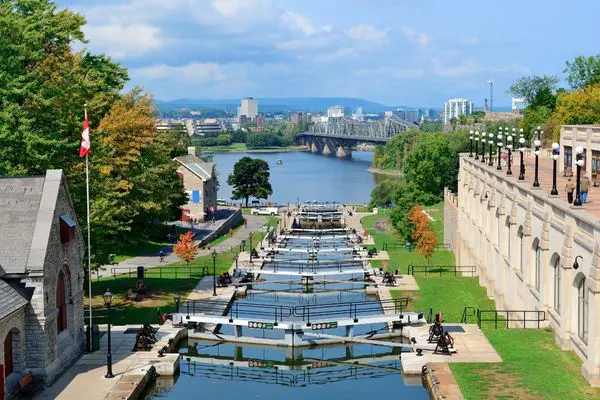
If you visit in the winter, you’ll experience why Ottawa is the 7th coldest capital in the world—but also the most fun. The Rideau Canal, a UNESCO World Heritage site, transforms into the Skating Rink, a 7.8-kilometer frozen highway that winds through the heart of downtown.
Pro Tip: You haven’t truly experienced Ottawa until you’ve skated the canal with a BeaverTail (a delicious, flat cinnamon-sugar pastry) in hand.
People and Language
Ottawa is a truly multicultural mosaic. Approximately 25% of residents were born outside of Canada, contributing to a rich culinary and cultural scene.
While English is the primary language for 62% of the population, roughly 40% of residents are bilingual (English and French). You’ll hear a symphony of languages in the historic ByWard Market, including Arabic, Chinese, Italian, and Spanish.
Urban Architecture and Transport
The city’s skyline is dominated by the Peace Tower and the Gothic Revival splendor of Parliament Hill. Most domestic architecture reflects a “Romantic and Picturesque” style, with red-brick homes and tree-lined streets defining neighborhoods like the Glebe and Rockcliffe Park.
Getting Around:
- LRT (Light Rail Transit): The O-Train system has seen massive expansions by 2026, connecting the eastern and western suburbs to the downtown core.
- Biking: Ottawa is a cyclist’s dream, with hundreds of kilometers of dedicated pathways that are completely separated from car traffic.
Agriculture in the City
Unique among major global capitals, Ottawa is a powerhouse of agriculture. It has more farmland than any other city in Canada. This allows for a “farm-to-table” lifestyle that is literal rather than just a marketing slogan.
The Ottawa Smart Farm, located within the Greenbelt, is currently a leader in sustainable “AgTech,” testing drones and AI to help feed the growing global population.
Conclusion
Ottawa in 2026 is no longer just a place for politicians; it is a city of scientists, artists, and adventurers. It is a place where you can tour a nuclear bunker (the Diefenbunker) in the morning, attend a world-class tech conference in the afternoon, and be hiking in the Gatineau Hills by sunset.
