The Philippines continues to be a major labor-exporting nation, with a steady flow of Filipinos seeking opportunities abroad to provide for their families. However, the landscape has shifted significantly since 2019, influenced by a post-pandemic recovery and new economic challenges.
The employment landscape in 2026
The Philippines’ unemployment rate has shown volatility recently. As of November 2025, the unemployment rate stood at 4.4%, a notable increase from the 3.2% recorded a year prior. While this is an improvement from the 5.2% seen in 2019, it reflects a cooling economy following a period of high inflation and global uncertainty.
Regional comparison (2024-2025 estimates)
The Philippines remains in the middle of the pack compared to its neighbors, many of whom have maintained tighter labor markets:
| Country | Unemployment Rate (2024-2025) |
|---|---|
| Thailand | 0.7% — 1.0% |
| Vietnam | 1.4% — 2.0% |
| Singapore | 1.9% — 3.2% |
| Malaysia | 3.2% — 3.8% |
| Indonesia | 3.3% — 5.0% |
| Philippines | 4.4% |
| China | 5.0% — 5.2% |
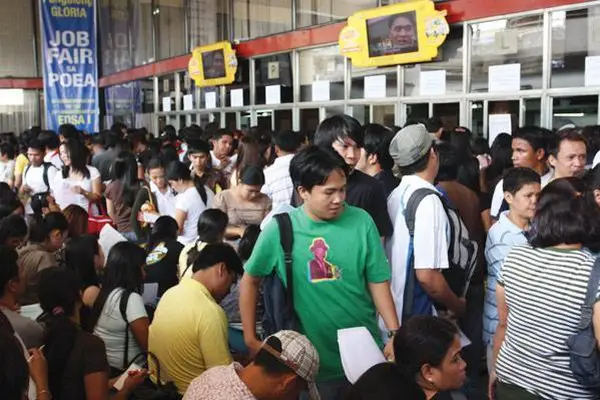
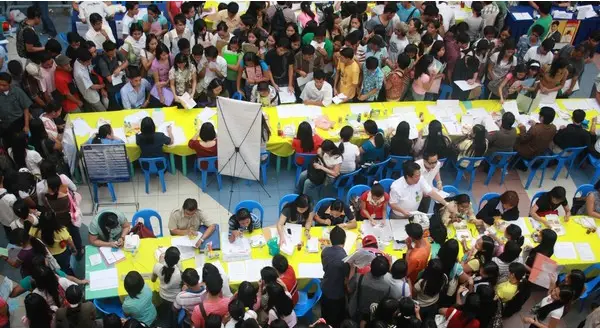
Every year, nearly 900,000 new entrants join the Philippine labor force. A significant portion of the unemployed continues to be fresh college graduates who struggle to secure immediate placement in a competitive and shifting market.
Core challenges to Philippine employment
Persistent skill mismatch
This might be one of the biggest reasons behind the high unemployment rate in the country. The “mismatch” is the gap between what schools teach and what industries actually need.
The Technical Education and Skills Development Authority (TESDA) often identifies “Hard-to-Fill” vacancies in construction and high-tech manufacturing, while at the same time, thousands of graduates are finishing over-saturated courses like Business Administration. This results in “educated unemployment,” where people have degrees that the current market simply doesn’t value.
During the “Nursing Boom,” the Philippines produced so many nurses that hospitals couldn’t hire them all, leading to thousands of nurses working in call centers. Today, we see a similar trend where students flock to general “Information Technology” degrees but lack the specific “Cybersecurity” or “Cloud Computing” certifications that 2026 employers are actually looking for.
The poverty cycle
Poverty acts as both a cause and a consequence of unemployment. While the Philippine Statistics Authority (PSA) reported a decrease in poverty incidence to 15.5% in 2023, millions of families remain “chronically poor.” For these families, the cost of finishing a four-year degree is insurmountable. This forces the youth into the “informal economy”—low-paying, unstable jobs like street vending or “extra” construction work—which offer no path for skill-building or upward mobility.
A “working student” from a low-income family might have to drop out in their third year of college to work as a delivery rider to pay for a sibling’s medical bills. Without that degree, they are barred from most corporate jobs, keeping them in the same financial bracket as their parents.
Population dynamics
The Philippines’ population reached approximately 112.7 million in 2024, and while the growth rate has slowed to about 0.8% annually, the “youth bulge” remains a double-edged sword.
According to the Commission on Population and Development, the country is currently in a “demographic window” where the working-age population outnumbers dependents. However, if the economy does not create roughly 800,000 to 1 million new jobs annually, this potential “demographic dividend” turns into a “demographic time bomb” of unemployed, frustrated youth.
Imagine a typical graduation season in a mid-sized city like Iloilo or Cagayan de Oro. While 5,000 students might graduate in a single weekend, the local economy may only have 500 new job openings. This forces the remaining 4,500 to either migrate to Manila or seek work overseas, draining the province of its best talent.
Governance issues and policy gaps
The persistence of high unemployment is often linked to bureaucratic hurdles and inconsistent policy implementation. While the Philippine government has introduced various “Ease of Doing Business” initiatives, many local and foreign investors still face “red tape” that delays project approvals and job creation.
Furthermore, there is a lack of cohesive long-term planning between the Department of Labor and Employment and the Department of Education. This “policy silo” means that educational reforms often lag years behind the actual needs of the industrial and service sectors.
Corruption and high utility costs—specifically electricity—also deter labor-intensive manufacturing firms from setting up shop in the Philippines compared to Vietnam or Thailand. Without a more aggressive policy shift toward protecting local industries and lowering the cost of business operations, the country remains reliant on the service sector (like BPOs), which cannot absorb the entire labor force, especially those in rural areas with limited infrastructure.
Discrimination and high entry barriers
Despite the Anti-Age Discrimination in Employment Act (RA 10911), “hidden” discrimination remains rampant. Many job postings still subtly prioritize younger applicants or set unrealistic “physical” standards.
Furthermore, the requirement for NBI clearances, police clearances, and medical exams creates a financial barrier for the very people who need jobs most. A study by Philippine Institute for Development Studies has previously noted that these “transaction costs” of applying for a job can exceed a week’s worth of minimum wage.
You may see a job posting for a “Sales Clerk” that requires the applicant to be “under 28 years old” and have a “pleasing personality.” This effectively disqualifies a highly experienced 35-year-old mother who is looking to return to the workforce, regardless of her actual sales ability.
Geographic inequality and regional job concentration
Economic opportunities in the Philippines are heavily concentrated in NCR, CALABARZON, and Central Luzon, which together account for over 60% of the country’s GDP. This geographic imbalance forces “internal migration,” where workers from the Visayas and Mindanao flock to Manila, leading to overcompetition in the capital and a “brain drain” in the provinces. The Department of Trade and Industry has pushed for “Balik Probinsya” programs, but without industrial hubs in rural areas, these efforts often stall.
An IT graduate from Leyte often finds that the only way to earn a “professional” salary is to move to a BPO hub in Cebu or Metro Manila. This leaves their hometown with plenty of graduates but no local companies to employ them, stunting the town’s economic growth.
The quality gap in graduates
There is a growing concern that “finishing school” does not equal “ready for work.” The World Bank’s Human Capital Index has highlighted that Philippine learners often struggle with foundational literacy and numeracy.
This translates to the professional world where, as of 2024, licensure exam passing rates for professions like Criminology and Elementary Education frequently hover below 50%. Employers often complain that while applicants have diplomas, they lack critical thinking and “soft skills” like professional communication.
A company hiring for a customer service role may interview 50 college graduates but find that only 5 can effectively draft a professional email or solve a complex logic-based customer problem without a script.
Impact of automation and digital transformation
The rapid acceleration of Artificial Intelligence and automation has fundamentally altered the Philippine job market, particularly within the Business Process Outsourcing sector. Tasks that once required entry-level human agents, such as basic customer support, data entry, and routine scheduling, are now being handled by sophisticated AI “agents.”
This shift has created a “barbell” labor market: there is a high demand for advanced software engineers and AI specialists, but a shrinking pool of opportunities for those with only general administrative skills.
Beyond the office, automation is also reaching the agricultural and manufacturing sectors. While these technologies increase overall productivity, the transition has been painful for workers who lack the digital literacy to pivot into new roles. Without a massive, state-led “upskilling” program to transition traditional workers into the digital economy, a significant portion of the population risks becoming technologically displaced and permanently unemployed.
Conclusion
Desperation for employment continues to make Filipinos vulnerable to scams, particularly via social media and SMS. While the government has set a goal to reduce poverty to a single-digit level by 2028, the solution cannot rely solely on the “safety valve” of labor export. To achieve sustainable growth, the Philippines must bridge the gap between its education system and the high-tech demands of the global economy.